
Back-to-School Anxiety Does Not Always Look Like Fear

When stomachaches, irritability, perfectionism, sleep trouble, and “I don’t want to go” are part of the anxiety picture
Susana Padilla, CHt | Hypnosis Haven
Back-to-school anxiety has a public face: a nervous child at the classroom door, a college freshman admitting they are homesick, a teenager saying they are worried about a new schedule.
But anxiety is not always that articulate.
Sometimes it says, “My stomach hurts.” Sometimes it looks like irritability at breakfast, tears over the wrong socks, a headache Sunday night, suddenly needing a parent nearby, lying awake long after bedtime, refusing to eat before school, or becoming unusually controlling about grades, clothes, routines, or timing.
And sometimes the student insists they are fine.

The Body May Notice the Transition First
The beginning of a school year asks the nervous system to take in a remarkable amount of change at once: different wake times, new teachers, unfamiliar classmates, new social expectations, bus routes, cafeterias, homework, sports, noise, separation, performance, and the simple uncertainty of not yet knowing how the year will feel.
The American Psychological Association notes that the transition back to school can be stressful for children and that fear of the unknown - new teachers, classmates, or difficult classes - is often part of that stress. That does not mean every uncomfortable first week is an anxiety disorder. It means transition itself can be demanding.
For some children and teens, the body becomes the first messenger. The stomach tightens. The bowel pattern changes. The heart races. Sleep becomes lighter. The jaw clenches. Appetite changes. A child may genuinely feel ill even when a medical evaluation does not reveal an acute illness.
“It’s Anxiety” Should Never Mean “It Isn’t Real”
One of the quickest ways to lose a child’s trust is to hear “my stomach hurts” and answer, “You’re just anxious."
The pain is still pain.
The National Institute of Diabetes and Digestive and Kidney Diseases describes irritable bowel syndrome in children as a disorder of brain-gut interaction. Emotional and mental-health factors can play a role in symptoms, and mental-health therapies may be part of treatment. The point is not that every school-morning stomachache is IBS. The point is that the brain and digestive system are in constant conversation.
Stress can be experienced physically. A child does not need to be pretending, exaggerating, or consciously creating the symptom for anxiety to be involved.
That distinction matters because children learn from the way adults interpret their bodies. We want to avoid teaching either extreme: “Ignore your body; it’s all in your head,” or “Every sensation means something is terribly wrong.” A steadier message is possible: “I believe you. Let’s understand what your body is telling us, and let’s make sure we respond appropriately."
Different Ages, Different Masks
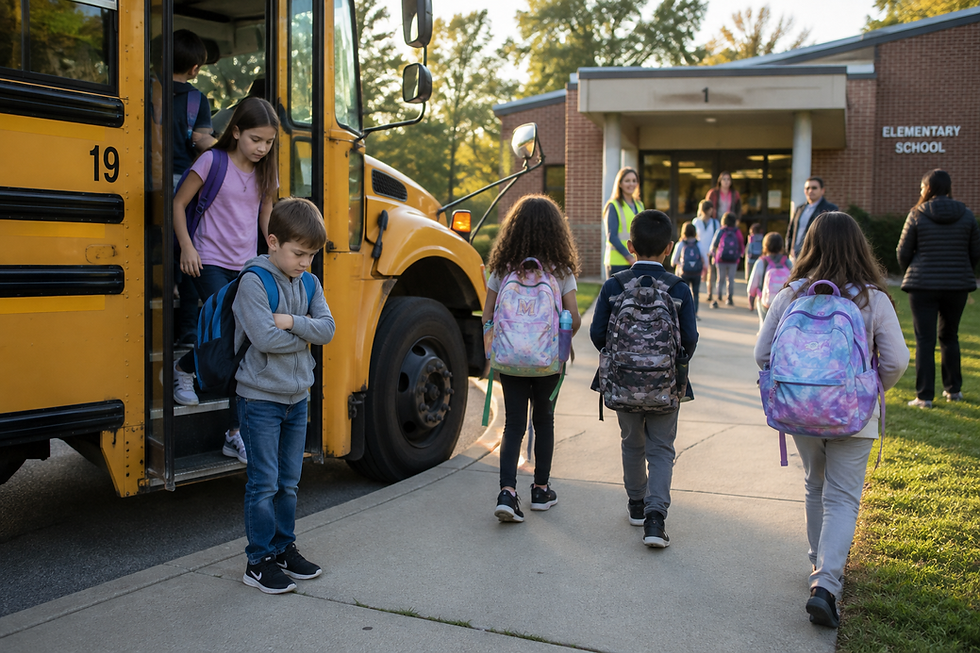
Elementary-school anxiety may appear as separation distress, repeated reassurance-seeking, morning stomachaches, sudden clinginess, sleep regression, crying at drop-off, or resistance that seems wildly disproportionate to the actual school day.
Middle-school students may become more concerned with belonging, embarrassment, appearance, peer judgment, changing bodies, academic comparison, or getting something “wrong” in front of everyone.
High-school anxiety often learns to dress itself as productivity. A student may look responsible while living in a constant state of anticipatory pressure: checking grades, overpreparing, procrastinating because the task feels enormous, sleeping too little, or feeling as though one mistake will alter an entire future.
College students face another kind of separation. Even confident young adults can be surprised by homesickness, social anxiety, roommate stress, academic pressure, panic symptoms, digestive changes, disrupted sleep, or the strange loneliness of being surrounded by people all day while feeling unknown.
The form changes. The underlying question is often similar: “Am I safe enough here to settle, learn, connect, and be myself?”
Anticipatory Anxiety: Suffering Before the Thing Happens
Anticipatory anxiety is the mind and body rehearsing a difficult future before the future has arrived.
Sunday night becomes Monday morning. August becomes the first day of school. One uncomfortable class becomes an imagined semester of humiliation. A student may begin reacting not only to what is happening, but to what the mind predicts could happen.
This is one reason logical reassurance sometimes has such limited reach. “You’ll be fine” may be true, but the body may already be practicing a different expectation.
The goal is not to argue a student out of every anxious thought. It is to help the system develop more flexibility: noticing the alarm, orienting to what is actually happening now, and building a different expectation through repeated safe experiences.

Where Hypnosis May Fit
Hypnosis can be a useful complementary approach when anxiety has become automatic: the racing mind at bedtime, the nausea before school, the panic response attached to a classroom, the fear of speaking, the stomach tightening before an exam, or the loop of “what if” thinking that seems to begin before conscious choice.
In hypnosis, we are not telling a child or student that nothing difficult will ever happen. We are helping them rehearse a more adaptive response to what does happen.
That may include imagery of arriving at school calmly, separating from a parent while maintaining a sense of connection, tolerating uncertainty, allowing the stomach to soften, sleeping before an important day, recovering after a mistake, or remembering that discomfort is not the same as danger.
With younger clients, the work should be developmentally appropriate and collaborative, with parent or guardian involvement. With teens and college students, autonomy matters enormously. They need to feel that the work belongs to them, not that hypnosis is another adult trying to make them behave.
When to Get More Help
Some back-to-school nerves settle as routines become familiar. Other symptoms deserve additional support.
If anxiety is interfering with attendance, eating, sleeping, learning, friendships, or daily functioning - or if physical symptoms are persistent, severe, or changing - it is appropriate to involve a pediatrician, primary-care clinician, mental-health professional, school support team, or other qualified provider. Physical symptoms should not automatically be attributed to anxiety without appropriate medical consideration.
Hypnosis is not a replacement for medical or mental-health care. It can sit beside that care, particularly when a student understands what is happening, but the automatic response has not caught up.
A Different Question for the First Weeks of School
Instead of asking only, “How do we make the anxiety stop?” we can ask something more useful:
What does this student need in order to feel capable of meeting what is here?
Sometimes the answer is information. Sometimes it is routine. Sometimes sleep. Sometimes a quieter morning. Sometimes a school accommodation, therapy, medical care, a different academic plan, or simply time.
And sometimes the nervous system needs practice experiencing the new situation without treating every uncertainty as an emergency.
Back-to-school anxiety does not always look like fear. But when we learn to recognize its quieter disguises, we can respond with more accuracy - and considerably more compassion.
Sources & Editorial Notes
These sources support the medical, psychological, and trend context used in the article. Hypnosis is presented as complementary support and not as a substitute for medical or mental-health diagnosis or treatment.
American Psychological Association. Back-to-school can be a stressful time. How to help your kids transition.
National Institute of Diabetes and Digestive and Kidney Diseases. Symptoms & Causes of Irritable Bowel Syndrome in Children. https://www.niddk.nih.gov/health-information/digestive-diseases/irritable-bowel-syndrome-children/symptoms-causes
National Institute of Diabetes and Digestive and Kidney Diseases. Treatment for Irritable Bowel Syndrome in Children.
Website disclaimer: This article is educational and is not medical advice. Persistent, severe, or concerning symptoms should be evaluated by an appropriately qualified healthcare professional. Hypnosis is complementary support; individual experiences vary.
When Anxiety Starts Showing Up in the Body
If back-to-school stress is showing up as stomachaches, sleep trouble, separation anxiety, panic, perfectionism, or a sense of overwhelm, hypnosis may be a useful complementary support.
I work with children age 9+, teens, and adults, with sessions tailored to the person, the pattern, and the goal.
Questions are always welcome. A brief confidential conversation can help determine whether hypnosis may be an appropriate fit.
10th Anniversary Offer: Three private sessions for $575 through August 31, 2026, or until the ten openings are filled.



Comments